A Jobs Report That Reset Expectations for the Fed
The U.S. labor market delivered a surprise in August, and it wasn't the one many economists were bracing for. Hiring accelerated well beyond forecasts, and the unemployment rate refused to budge from 4.1%, a combination that immediately shifted the conversation in financial markets away from whether the Federal Reserve would hold rates steady and back toward whether it would raise them at this month's policy meeting.
Payroll Growth Triples Forecasts
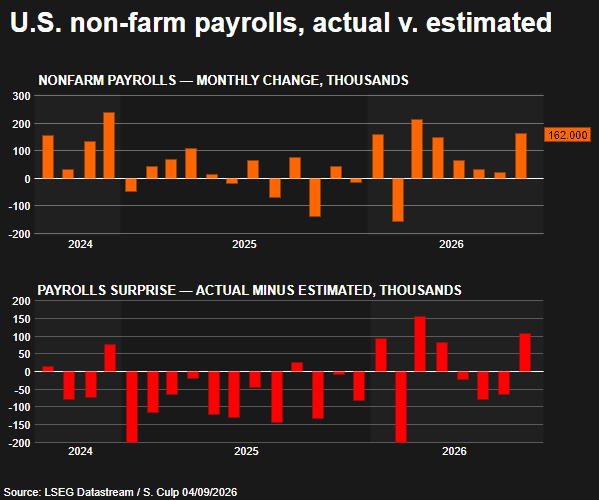
Employers added 162,000 jobs in August, the strongest single-month gain in five months and nearly three times the increase economists had penciled in. The result was made more striking by revisions to prior months, which added tens of thousands of jobs to the government's earlier estimates for June and July. Taken together, the data suggests the slowdown that worried policymakers earlier in the summer may have been more temporary than structural.
Where the Jobs Came From
Much of the rebound was concentrated in a handful of sectors. Leisure and hospitality, which had shed jobs for two straight months, bounced back sharply, with restaurants and bars driving a large share of the gain. Local government education payrolls also reversed a prior decline, and combined with a broader rebound in government hiring, these two areas accounted for more than half of the month's total job growth. Manufacturing, construction, and healthcare posted more modest increases, though healthcare's gain came in below its recent monthly average, a shift some analysts have linked to disruptions in the immigrant workforce following changes to Temporary Protected Status designations.
Not every corner of the economy added workers. The information sector and financial activities both lost jobs last month, losses that some economists attribute in part to companies leaning more heavily on artificial intelligence tools to handle work previously done by employees in those fields.
Unemployment Holds Steady as the Labor Force Grows
Perhaps the most reassuring detail in the report was that the unemployment rate didn't rise even as hundreds of thousands of Americans entered the labor force. The labor force participation rate ticked up to 61.6%, a partial recovery from earlier declines, though it remains below where it started the year. That combination, more workers looking for jobs without a corresponding jump in joblessness, is typically read as a sign of underlying labor market health rather than a statistical fluke.
Why Wall Street Sees This as a Fed Story
For investors, the significance of the report has little to do with hiring trends themselves and everything to do with what they imply for monetary policy. The Federal Reserve has been walking a careful line between supporting a labor market that showed signs of cooling earlier this year and containing inflation pressures tied to energy costs and geopolitical strain. A labor market running hotter than expected reduces the urgency for the Fed to ease and increases the odds that policymakers lean toward tightening instead.
The strength in hiring gives the more hawkish voices on the committee additional ammunition, especially with inflation not yet fully under control.
That shift in tone was visible almost immediately in interest-rate futures. Traders raised the implied probability of a quarter-point rate increase at the Fed's mid-September meeting to roughly 62%, up sharply from about 49% earlier in the week. The move partially reversed comments from a Fed governor who had suggested a case for holding rates steady if inflation data continued to cool, underscoring how quickly rate expectations can swing on a single data release.
Stocks, Bonds, and the Dollar React
Treasury yields climbed, reflecting both firmer growth expectations and lingering unease over inflation and the Fed's limited forward guidance. The dollar strengthened against a basket of major currencies, a typical response when markets price in a higher likelihood of U.S. rate increases relative to other central banks.
Housing and Consumers Feel the Ripple Effects
The rise in Treasury yields has already spilled over into the mortgage market. The average 30-year fixed mortgage rate climbed to its highest level in more than a year, adding further strain to a housing sector that has struggled with affordability. Higher borrowing costs could weigh on home sales and refinancing activity in the months ahead, even as the broader labor market shows resilience.
A rate increase at this point may actually create less uncertainty for markets than another meeting where policymakers simply choose to wait and see.
The Cracks Beneath a Strong Headline Number
Despite the encouraging top-line figures, several details point to a labor market that is solid but uneven. The number of Americans unemployed for 27 weeks or more rose by more than 150,000, and the median duration of unemployment climbed to 11.4 weeks, edging closer to a multi-year high reached earlier this year. Wage growth, meanwhile, actually slowed slightly, rising 3.1% over the past 12 months compared with 3.2% in July, a sign that the report's strength has not translated into a fresh source of inflationary pressure from labor costs. Economists also note that a shrinking labor pool, driven by immigration policy changes and slower population growth, has lowered the number of jobs the economy needs to create each month just to keep the unemployment rate stable, meaning strong headline job growth may not fully reflect underlying momentum.
What Comes Next for Investors
Attention now shifts to next week's Consumer Price Index report, which is likely to be the deciding factor in whether the Fed follows through on a rate increase at its September meeting. If inflation data comes in hotter than expected, it would reinforce the case built by this jobs report. A cooler reading, on the other hand, could revive the argument for holding rates steady.