Stronger Jobs Data Rattles Markets Ahead of Long Weekend
U.S. equities pulled back Friday as an unexpectedly strong employment report reshaped investor expectations for the Federal Reserve's next move on interest rates. The retreat, which touched all three major benchmarks, came just before markets closed for the Labor Day holiday, adding an extra layer of caution to an already jittery trading session.
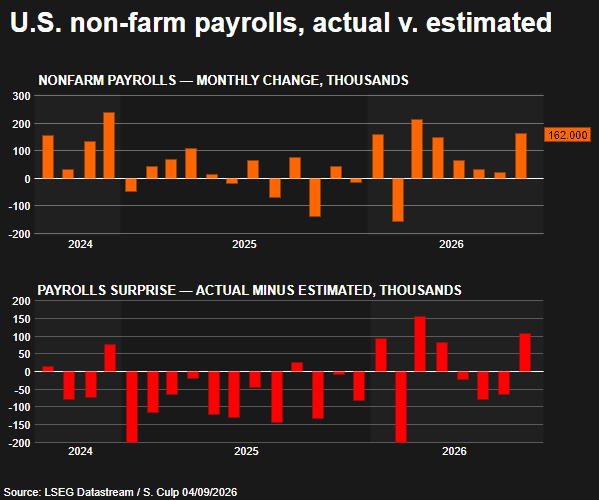
The catalyst was the Labor Department's August payrolls report, which showed employers added roughly 162,000 positions, nearly triple what economists had penciled in. Revisions to the prior two months added another 55,000 jobs to the tally, while the unemployment rate held steady at 4.1% even as more workers entered the labor force. On paper, it was a picture of resilience. On Wall Street, it read as a warning sign.
Why Good Economic News Spooked Investors
In a typical environment, a hiring surge of this magnitude would be cause for celebration. But with the Fed still watching inflation risks tied to elevated energy prices from ongoing geopolitical tensions, a hotter labor market complicates the central bank's calculus. A tight jobs market tends to support wage growth, and sustained wage growth can filter into broader price pressures, exactly the kind of dynamic policymakers are trying to avoid reigniting.
That tension was reflected almost immediately in interest-rate futures. According to CME Group's FedWatch tool, the probability traders assigned to a quarter-point rate increase at this month's Federal Open Market Committee meeting jumped to nearly 58%, up sharply from roughly 49% just a day earlier. That kind of single-day shift in rate expectations is unusual and underscores how sensitive markets remain to incoming economic data.
The labor market had a nice snapback last month, and it's hard not to see an improving job market as a positive for the economy overall, even if it raises the odds of a Fed hike given how hot conditions remain.
How the Major Indexes Performed
The Dow Jones Industrial Average shed roughly half a percent to close near 53,414, while the S&P 500 slipped about 0.4% to settle near 7,718. The tech-heavy Nasdaq Composite held up slightly better, easing about 0.3% to finish near 26,507. Trading volume came in below the recent 20-day average, suggesting some investors chose to sit on the sidelines ahead of the extended holiday break rather than make aggressive moves in either direction.
Winners and Losers Across Sectors
The selloff was uneven across industries. Consumer discretionary names bore the brunt of the decline, while industrial and technology shares managed modest gains. Semiconductor stocks stood out as the day's strongest performers, climbing more than 3%, though the group remains down nearly 18% for the quarter after a difficult stretch. Software and services stocks, by contrast, gave back more than 2% after posting strong year-to-date gains, a reminder that richly valued growth sectors can be first to pull back when rate expectations shift.
Individual stock moves added to the day's volatility. Shares of activewear retailer Lululemon fell sharply, down roughly 17%, after the company lowered its full-year sales and profit guidance, a sign that discretionary spending may be softening even as the broader labor market stays firm. Adobe shares also dropped, sliding nearly 7% following news that longtime chief executive Shantanu Narayen will hand the reins to an internal successor, a leadership transition that added uncertainty for investors already digesting the software sector's broader pullback.
Credit Bureaus Slide on Regulatory Shake-Up
Credit-reporting companies were among the session's steepest decliners after the head of the Federal Housing Finance Agency directed mortgage giants Fannie Mae and Freddie Mac to allow lenders to use an alternative credit-scoring model alongside the traditional FICO score. The announcement raised concerns about reduced pricing power for incumbent scoring providers, sending shares of Fair Isaac down roughly 17%, TransUnion down nearly 6%, and Equifax down more than 6%. The move highlights how regulatory decisions, not just macroeconomic data, can move entire sectors in a single session.
What Investors Should Watch Next
With markets closed Monday for the Labor Day holiday, attention now turns to next week's inflation data, including the consumer and producer price indexes, which should offer a clearer read on whether price pressures are broadening or staying contained. Those reports, combined with any fresh commentary from Fed officials, are likely to be the deciding factor in whether this month's rate decision goes forward as markets currently expect.
Market Outlook: Balancing Growth Against Inflation Risk
For now, the market's reaction underscores a familiar late-cycle dilemma: economic strength that would normally be welcomed is instead being weighed against the risk of tighter monetary policy. Investors appear willing to accept some near-term volatility if it means the Fed can keep inflation in check without derailing growth. Whether that balance holds will likely depend less on any single data point and more on the cumulative signal sent by next week's inflation readings and the Fed's own guidance in the days ahead.