A new treaty in Canberra
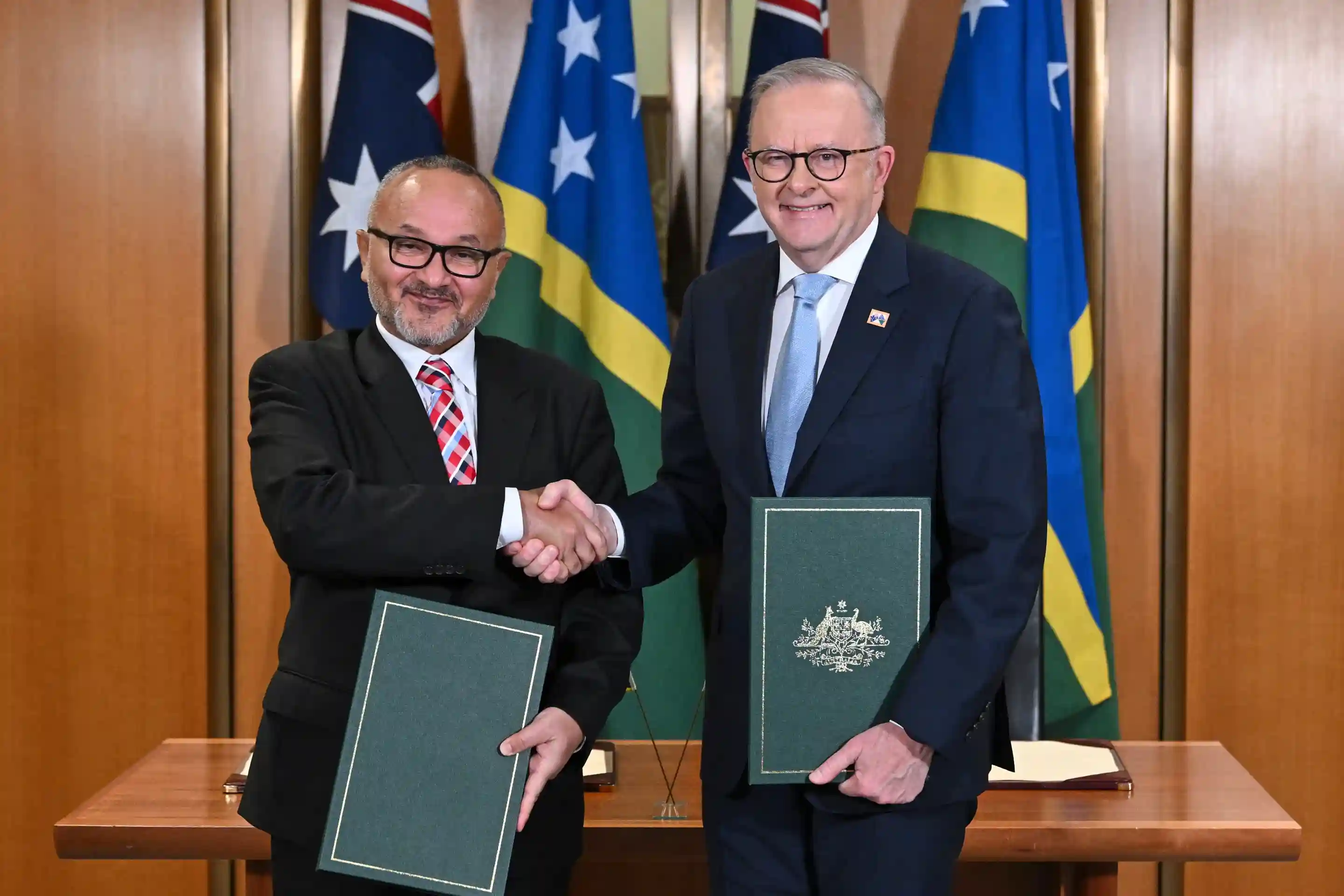
The prime ministers of Australia and Solomon Islands signed a bilateral security pact on Wednesday, following reports that the small South Pacific nation will end its secretive four-year-old defense deal with China.
The new treaty confirms Australia as the Solomons' "primary security partner" and states that "there will be no foreign military or security base" in the country, which lies about 2,000 kilometers (1,200 miles) northeast of Australia. Prime Minister Anthony Albanese and his Solomon Islands counterpart, Matthew Wale, said so in a joint statement.
Albanese said the agreement lifts relations between the two countries to a level that has "never been seen before and has never been stronger."
Australia's wider push in the Pacific
The pact is the latest bilateral security agreement Australia has struck with Pacific neighbors since Beijing signed a treaty with the Solomons' previous government in 2022, a move that raised fears the Chinese navy could build a base in the South Pacific.
Since Albanese's government was first elected in late 2022, Australia, a staunch U.S. ally, has tried to edge Chinese influence out of the region through agreements with countries including Fiji, Tuvalu and Vanuatu. In 2024 it also reached a security-linked pact with Papua New Guinea, its nearest neighbor, that promised 600 million Australian dollars ($396 million) over a decade and included a place for a Papua New Guinea rugby league team in the Australian national competition.
More than a security deal
The treaty reaches beyond defense. Australia has also agreed to invest in the Solomons' infrastructure, education, renewable energy and sport.
Oliver Nobetau, the Pacific Islands program director at the Lowy Institute, a Sydney think tank, called the treaty significant and fine-tuned to the Solomons' priorities. He told the Australian Broadcasting Corp. that it shows Australia is listening to what its Pacific partners want.
Why the treaty matters
For Canberra, the agreement is a way to lock in a partnership with a country whose previous government signed a security deal with Beijing four years ago. By writing the "primary security partner" language and the ban on foreign bases into a treaty, Australia and the Solomons have put in a formal document what had been a matter of concern since 2022.
For Honiara, the deal pairs security cooperation with investment in everyday priorities such as schools, infrastructure, clean energy and sport. That mix is what Nobetau meant when he said the treaty was tailored to what the Solomons want.
Wale described his country's past as one of uncertainty and doubt for the wider region, and said those days were over. He did not spell out what that means for the China agreement, and he said talks with Beijing are continuing.
What happens to the China pact?
Wale would not confirm or deny media reports that his government told Beijing the security pact with China would not be renewed when it expires after five years in early 2027. That agreement has brought Chinese police trainers to the capital, Honiara.
"Unfortunately there is a non-disclosure clause in the treaty with China," Wale told reporters at a news conference with Albanese at Australian Parliament House. "So I am unable to talk about that. We have ongoing discussions with China."
"Solomon Islands has been, for a number of years, a source of uncertainty and doubt in the region. Those days are done. Gone." — Matthew Wale
Wale added that his country does not want to return to that position.
Beijing's response
In Beijing, Foreign Ministry spokesperson Guo Jiakun did not directly answer a reporter's question about whether the Solomons had said it would end the Chinese security pact. Speaking on Tuesday, he said China follows the principle of mutual respect and equality in developing relations with the Solomon Islands.
Guo added that there is no element of geopolitical rivalry or bloc confrontation in cooperation between China and Pacific island countries, including the Solomon Islands.
For now, the Solomons' position on the Chinese agreement remains publicly unconfirmed, but the new Australian treaty makes clear which partner it has named first. The next sign will come as the Chinese pact approaches its expiry in early 2027.