Asia follows Wall Street lower
Most Asian stock markets closed lower on Monday after a harsh sell-off in artificial intelligence stocks dragged the S&P 500 down 3.7% on Friday. Tech-heavy markets took the worst of it, with South Korea's benchmark falling by the most among the major regional gauges.
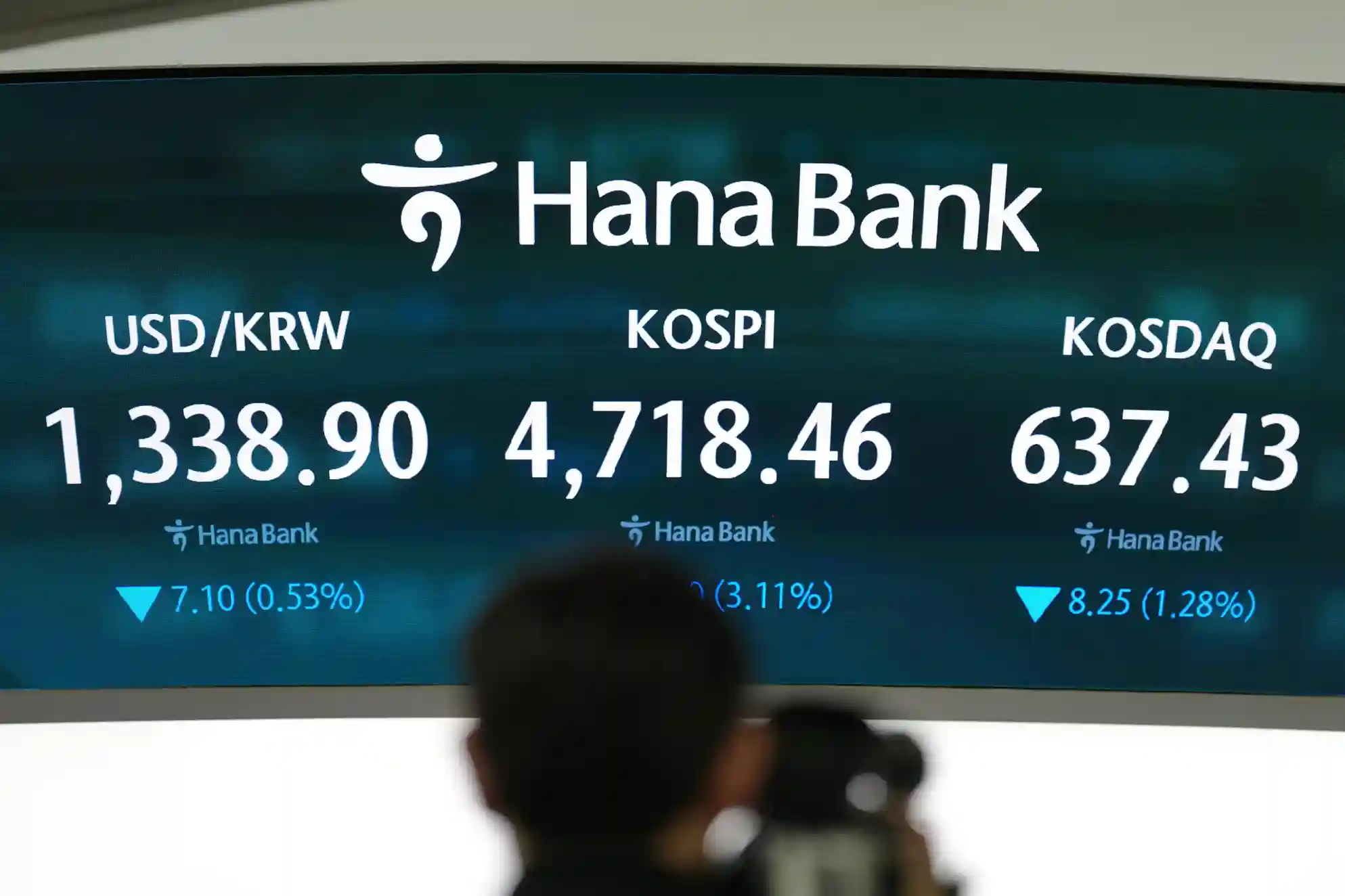
The Kospi dropped 5.8% to 4,586.80. Samsung Electronics lost 5.5% and SK Hynix fell 4.9%, two chip names that are closely tied to the global AI buildout. Markets in Tokyo were closed for a holiday.
Hong Kong, Shanghai, Taiwan and Australia
In Hong Kong, the Hang Seng index shed 1.8% to 22,015.86, while the Shanghai Composite declined 1.4% to 3,484.53. Taiwan's Taiex lost 0.6%, a smaller drop than South Korea's despite the island's heavy exposure to chip makers.
Australia was the calmest corner of the region. The S&P/ASX 200 slipped just 0.1% to 8,589.10.
US futures point to a bounce
There was some relief in early Monday trading for the US. Futures for the S&P 500 rose 1.9%, and futures for the Dow Jones Industrial Average gained 1.6%, suggesting investors expected at least a partial rebound after Friday's steep decline.
What happened on Wall Street
After Friday's drop, the S&P 500 is in what professional investors call a correction, meaning it has fallen more than 10% from its all-time high, which was set on Oct. 6. The last correction came in March 2025, when the Trump administration's trade war rattled markets.
The Nasdaq composite, which is heavily shaped by tech stocks, slumped 5.3% and moved into negative territory for the year. The Dow fell 1.9%.
Chip stocks took the brunt of the selling. Nvidia, Micron Technology, Broadcom and Advanced Micro Devices all fell sharply, and other companies tied to the AI buildout, including optical products maker Corning and energy provider Bloom Energy, also tumbled. The AI lab Anthropic, which had just completed a successful IPO on Thursday, dropped 8.5%.
Nvidia and Anthropic in focus
Nvidia, which many see as the poster child of the AI boom, closed 14% lower and has fallen on nine of the last 10 trading days. The stock has been hit by anxiety over the strength of the AI buildout, and more recently by worries about the company's future after the sudden downfall of Jensen Huang, its former CEO and co-founder. Since that scandal broke earlier this month, Nvidia has lost more than 30%.
Anthropic, the maker of the Claude AI tool, saw its big Thursday debut fizzle on Friday along with the rest of tech. Its stock fell 8.5% to $88.91, still above the $83 IPO price. It was the biggest public offering ever and at one point passed $2 trillion in value. Friday's fall is about 23% from its brief peak of $115.10 a day earlier.
Behind the slide is a growing worry that AI stocks' large market values and heavy spending cannot be justified, a concern that has been dragging on the trade for some time.
Consumers brighten while markets sour
While the stock market's mood has soured, American consumers appear to be feeling better, reversing the pattern seen earlier this year. The University of Michigan's latest consumer sentiment index rose sharply from October and came in slightly ahead of what economists expected.
Consumers pointed to relief from easing gas prices and better expectations for business conditions after the midterm elections. Even so, sentiment is still below where it stood in February, before the start of the U.S. war with Iran.
Oil and currencies
In other early Monday trading, Brent crude, the international benchmark, lost 0.5% to $92.10 a barrel, and U.S. benchmark crude slipped 0.3% to $83.13 a barrel.
The U.S. dollar rose to 158.88 Japanese yen from 158.62 yen. The euro edged up to $1.10987 from $1.10973.