A collision on the Mississippi
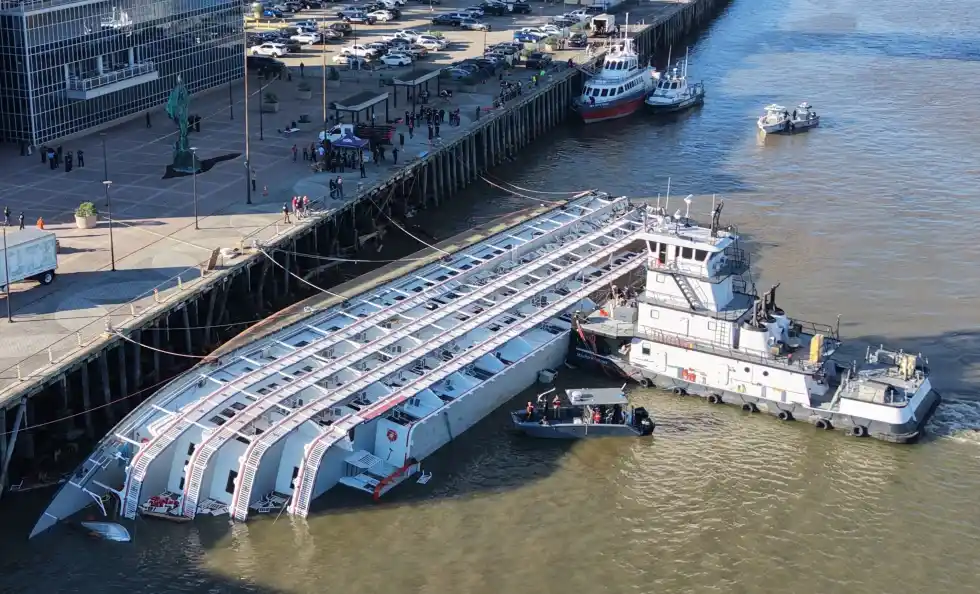
U.S. authorities are investigating why a tanker on the Mississippi River slammed into a smaller river cruise ship docked in New Orleans, sending dozens of people into the water. All 190 passengers and crew aboard the cruise ship survived the collision on Friday, and officials said no one suffered critical injuries. New Orleans Mayor Helena Moreno called it "a miracle on the Mississippi."
What went wrong
The National Transportation Safety Board is investigating why the Atlantic Asphalt, a 520-foot (160-meter) tanker, struck the cruise ship. The cruise ship's crew had handed out life jackets and was evacuating passengers when the vessel overturned, which sent dozens of people into the river.
According to New Orleans officials, 32 people were taken for treatment on Friday, and four were still hospitalized on Monday. One of those four was in serious condition.
NTSB officials said Sunday that the tanker's steering system failed, leaving its rudder stuck. The ship veered toward the river's east bank and hit the docked cruise ship. Investigators are still trying to learn what caused the steering failure.
Salvatore Mercogliano, a maritime historian at Campbell University in North Carolina, said the most likely cause is a mechanical breakdown in the ship's hydraulic or electrical systems, though he said human error could also have played a part. U.S. Coast Guard records show no problems were reported at the tanker's last inspection on Oct. 19.
The tanker and its owners
According to the ship-tracking website MarineTraffic, the Atlantic Asphalt was built in 2017 and specializes in carrying large quantities of asphalt and bitumen, a semi-solid material often used in road construction and roofing.
The International Maritime Organization lists the owner as Nave Shipping SA, registered in Monrovia, Liberia. Nave Shipping is a subsidiary of the China State Shipbuilding Corporation, a sprawling Chinese state-owned conglomerate.
The company that manages the tanker, OSM Thome, expressed regret over the collision in a weekend statement. "OSM Thome is fully complying with the local authorities as they carry out the necessary investigations," it said. The company did not immediately answer an email seeking more comment on Monday.
Earlier mechanical problems
Inspections at U.S. and Canadian ports found more than a dozen safety and mechanical problems on the Atlantic Asphalt over the past seven years. In July and August 2024, the Coast Guard recorded back-to-back malfunctions. First, the captain reported that the autopilot was not working properly as the ship headed to Baltimore. The following month, the tanker experienced a loss of communication between the bridge and the main engine, according to a Coast Guard report.
Mercogliano said those issues seemed fairly common and not especially worrying, as were six other mechanical deficiencies the Coast Guard has reported on the ship since 2019. Coast Guard documents show all of them were soon fixed. The most recent one, reported in June, was faulty wiring to the lighting in the ship's pump room.
Inspections at Canadian ports also turned up problems, including four fire-safety deficiencies in 2024 and an issue last year with the emergency electrical generator, according to public maritime records.
What happens next
The NTSB released no new information on Monday. A spokesperson said the agency expects to publish a preliminary report on the crash within 30 days. A 16-member team plans to spend a week in New Orleans investigating.
The NTSB said it recovered the tanker's voyage data recorder, which is similar to an airplane's flight data recorder and holds information such as the ship's speed and audio from the bridge. Investigators have also asked anyone with photos or video of the crash to send them in.
Lawsuits and the cleanup
Port of New Orleans officials have filed a federal lawsuit saying the tanker caused at least $1 million in damage to the port's terminal. A judge issued a warrant giving U.S. officials control of the tanker, which was towed away from the crash site.
The tanker's owners also face a personal injury lawsuit filed over the weekend by four crew members of the cruise ship, who say they "suffered significant and life changing injuries" because of the owners' negligence. Court records listed no attorneys for the tanker's owners.
The cruise ship is still on its side in the river, and moving it could take weeks, the Coast Guard said. Crews must first remove 16,000 gallons (60,500 liters) of fuel from the vessel.