A new military pact with Caracas
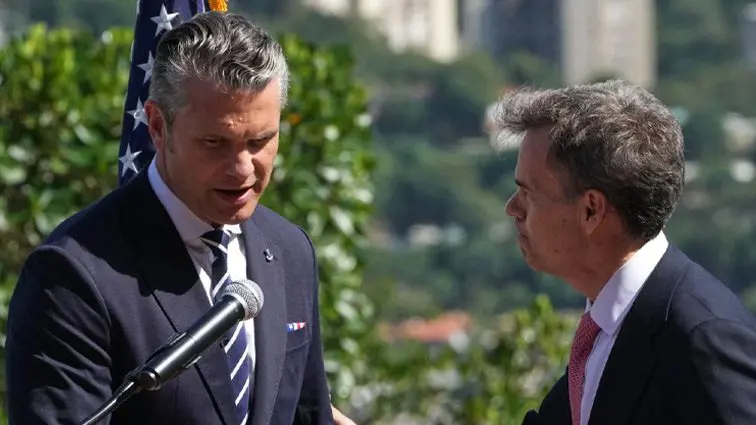
The United States and Venezuela have signed a deal to reestablish military ties, covering everything from joint training to intelligence sharing, U.S. Defense Secretary Pete Hegseth said Wednesday in Caracas. He made the announcement while visiting the interim leaders of the South American country.
Hegseth spoke about the January capture of then-President Nicolás Maduro by U.S. forces and told an audience of diplomats and military officials from both countries that Venezuela "has gone from our most aggressive regional threat to a compliant security partner." He also praised what he called "close cooperation" with acting President Delcy Rodríguez, which he said allowed officials "to stabilize Venezuela and rid it of narco-terrorists once and for all."
The visit is the latest stop in Venezuela by a member of President Donald Trump's Cabinet and shows the administration's push to deepen its influence in the country. Trump said in August that Hegseth helped broker a sweeping deal for the U.S. to take control of some Venezuelan oil reserves.
Few details on the agreement
Hegseth gave few specifics. He said only that the two militaries would be "training together, partnering together, sharing intelligence, more defense equipment and capabilities together." Speaking separately, Rodríguez said she hoped military cooperation "can be brought to its highest possible level" so the countries can "address common threats."
Hegseth said Venezuela is partnering with the U.S. "to recover its territory from narco-terrorist networks." The Pentagon did not immediately offer more details about the new partnership.
Oil, Iran and the Strait of Hormuz
Hegseth also praised the Venezuela oil deal by pointing to another major military action this year, the Iran war. That conflict has disrupted global energy supplies through a critical waterway in the Persian Gulf, raised gasoline prices and contributed to the Republican Party's severe losses in this month's midterm elections.
The Venezuela oil deal "makes the Strait of Hormuz a nonfactor for the Western Hemisphere," Hegseth said at the U.S. Embassy in Caracas. Rodríguez said the deal enables "the energy development of our nations" and benefits the people of both countries.
Among those at the speech was Alejandro Betancourt, owner of North American Blue Energy Partners, the second-largest oil operator in Venezuela. The U.S. government and his company entered into the agreement to tap Venezuela's vast oil reserves. The Interior and Energy secretaries also visited earlier this year, focusing on oil and critical minerals, and Gen. Francis Donovan, head of U.S. Southern Command, has met interim authorities at least twice. After Caracas, Hegseth stopped in Bogota, Colombia, where the defense and foreign ministers greeted him at a military base.
A wider focus on Latin America
The U.S. military has been turning more of its attention to the region since Trump returned to the White House last year, with the president promising to focus on the Western Hemisphere and fight Latin American drug cartels.
American forces have been attacking boats that the administration says are smuggling drugs in the Caribbean Sea and the eastern Pacific Ocean. At least 240 people have been killed since the administration began targeting those it calls "narco-terrorists" in September 2025. U.S. officials have released little public evidence that the vessels carried drugs or that the strikes have affected drug availability in the country.
Hegseth also boasted about the operation that seized Maduro, calling it "the single most sophisticated military operation in the history of Latin America" that "lasted just 48 minutes." He added that America's best warfighters "solved a 27-year problem for this hemisphere in a matter of hours," and turned a Maduro catchphrase back on him, saying the operation ended with "no war, yes, peace."
Still, Venezuela's ruling party, which has held power since 1999, continues to lead the country, now with Rodríguez in charge.
Uncertainty over who leads Venezuela
The visit comes as Venezuelans are unsure who will lead the country in the months and years ahead. Rodríguez, a Maduro ally, took over after his capture. Although her court-allowed term expired in July, she has continued to act as head of state. Hegseth praised her leadership and thanked her for working "closely and pragmatically and diligently" with the U.S.
Meanwhile, opposition leader María Corina Machado recently returned to Venezuela from exile after seven failed attempts that opposition activists said the government blocked. Secretary of State Marco Rubio has said her safe return was the result of reconciliation talks supported by the U.S., which he called the best opportunity in three decades for free and fair elections and lasting democracy.
With no date set for the next presidential election, many Venezuelans are conflicted about Trump. They are relieved Maduro is gone, but many believe the White House was wrong to put reviving the oil industry ahead of pro-democracy steps if it wants meaningful change.